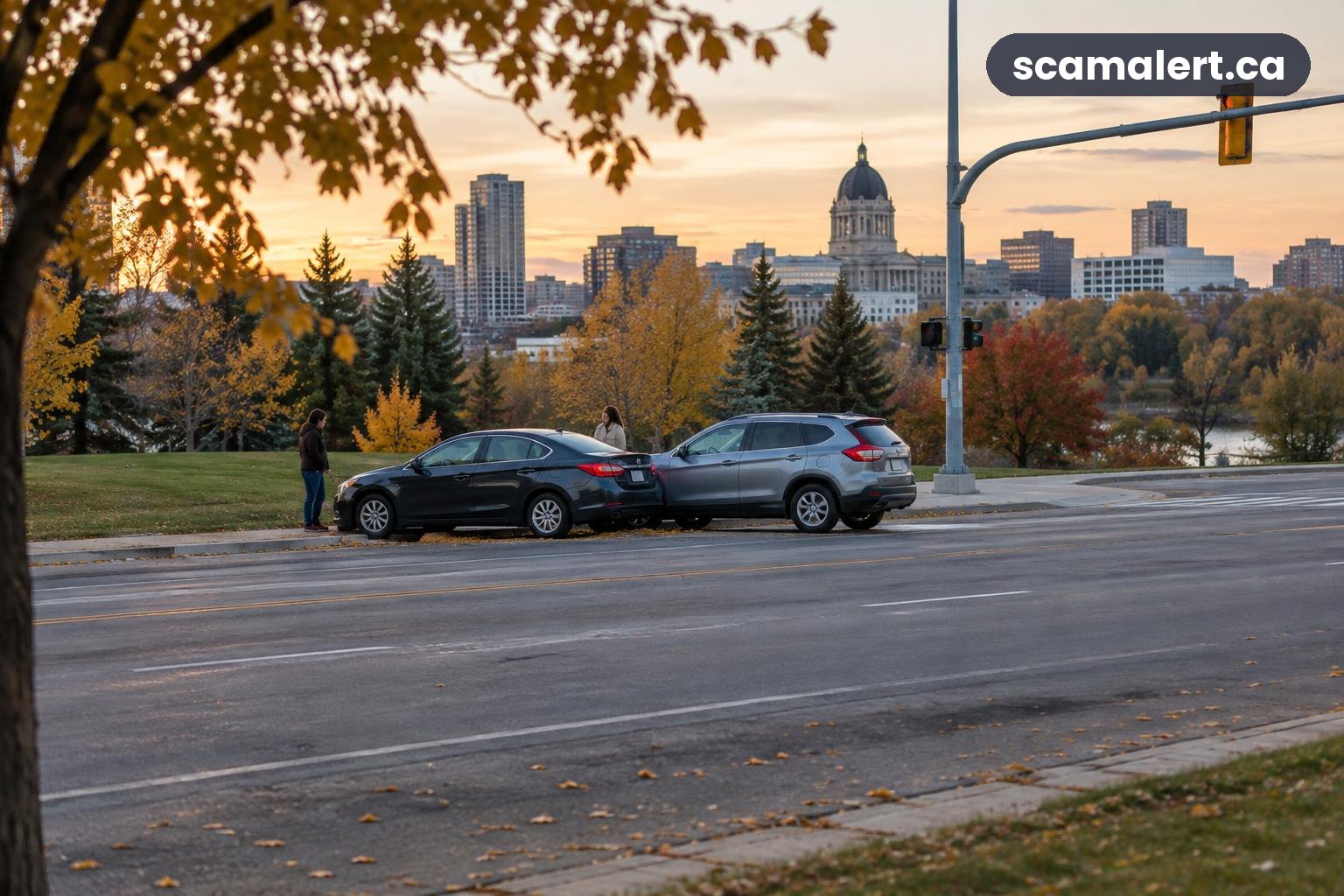
A staged collision scam can put drivers under pressure after a crash, especially when people disagree about what happened or who is responsible. CTV News reports that a staged vehicle collision in Regina led to fraud charges; a charge is an allegation, not proof of guilt.
Drivers should treat any collision seriously, get help if needed and make a careful record of what they observe. The steps below can help you protect your safety, your insurance claim and your personal information without trying to investigate or confront anyone yourself.
What the staged collision scam can look like
A staged collision involves a crash that is deliberately caused or misrepresented to support a false insurance claim. The details can vary. In some schemes, a driver may make an unexpected manoeuvre that leads another motorist to hit their vehicle; in others, someone may claim damage or injuries that were not caused by the collision.
These are general examples of how staged-crash fraud can work, not details about the Regina case. A confusing collision, sudden braking or a disagreement about damage does not prove that anyone planned a crash. There can be ordinary explanations, and it is the job of police and insurers to assess evidence.
After a collision, someone might press you to accept blame, agree to a cash payment or use a particular repair shop or service provider. Those requests alone do not establish fraud, but you do not need to make an immediate decision. Keep the discussion factual, exchange the information required by your province and contact your insurer for guidance.
A staged collision scam can also involve misleading statements made later, such as an account of how the crash happened that does not match what you saw. Avoid arguing about motives at the roadside. Record your own observations as soon as you safely can, while they are fresh.
Red flags to watch for
- Pressure to settle immediately: Someone insists that you pay cash or agree to a private deal before you have spoken with your insurer. Do not let pressure replace the usual reporting and claims process.
- Requests to misstate what happened: A person asks you to change details, leave information out or agree to a description you believe is inaccurate. Give a truthful account, and tell your insurer if you are uncertain about any detail.
- Unusual demands for personal or financial information: Be cautious if someone asks for passwords, banking sign-in details or unrelated identity information. Share necessary claim information only through channels you have independently verified.
- Conflicting accounts or details: The other person’s description, vehicle damage or contact information may not seem consistent with what you observed. Note the specific differences rather than accusing anyone at the scene.
- Pressure to use a particular service: You are urged to use a specific repair shop, tow service or representative without time to check your options. Ask your insurer how to proceed and verify any provider before agreeing.
- People or vehicles appear to be coordinating: You notice conduct that seems unusual before or after the impact. Write down what you observed and share it with police or your insurer; do not follow anyone or put yourself at risk to gather more evidence.
- Repeated contact that feels threatening: Keep a record of calls or messages related to the collision. Do not respond with threats, and contact police if you feel unsafe.
Any one of these signs can have an innocent explanation. Red flags are reasons to slow down, keep records and ask your insurer or police for advice—not reasons to decide on your own that someone has committed a crime.
What to do if you’ve been targeted
- Put safety and health first. Move out of traffic if it is safe to do so. Call emergency services if someone needs urgent medical help or there is an immediate danger. Follow the collision-reporting requirements that apply where you are.
- Stay calm and keep the exchange factual. Do not argue about fault, accuse the other driver or admit to something you do not know to be true. Exchange the information required by law, and avoid signing blank forms or agreeing to a private payment under pressure.
- Make a record if it is safe. Note the time and location, what you saw before and during the collision, the direction each vehicle was travelling and what was said. Photograph vehicle damage, the roadway and relevant conditions only from a safe place. Do not put yourself in traffic or delay getting help to take pictures.
- Collect witness details. If anyone saw the collision, ask for their name and a way to contact them. Do not pressure a witness or try to coordinate accounts. Keep any dashcam footage or related messages in their original form.
- Contact your insurer promptly. Use a number or contact method from your policy documents or the insurer’s official website, rather than relying on contact details supplied unexpectedly by another person. Explain what happened, identify anything that concerns you and ask what records or next steps are needed.
- Keep documents and communications. Save claim paperwork, repair estimates, photographs, witness information and messages. Write down when you spoke with your insurer or police and any instructions you were given. Send accurate information and keep a copy for yourself.
- Protect accounts if you shared financial details. Contact your bank using its verified contact information if you gave someone banking details or made a payment you now question. Ask the bank what steps it recommends, and change exposed passwords from a trusted device if needed.
After a suspected staged crash
If a collision happened in Saskatchewan, your insurer can explain the claims process and where to report the incident. You can also check SGI’s official website for Saskatchewan auto-insurance and collision information. If you are insured elsewhere, contact your own insurer and follow the rules for your province or territory.
Do not try to prove a staged collision scam by confronting someone, following a vehicle or posting accusations online. A calm, detailed account is more useful: separate what you personally saw from what another person told you, and identify anything you are unsure about.
How to report it
Report suspected fraud to the Canadian Anti-Fraud Centre at 1-888-495-8501 or antifraudcentre-centreantifraude.ca. Share the information you have, such as the circumstances, messages or payment details, without altering records. Reporting helps authorities gather information, but it does not replace contacting your insurer or police.
Contact your local police service to report a suspected deliberate collision, threats or other potentially criminal conduct. Call emergency services if there is immediate danger or urgent medical need; otherwise, use the local police service’s non-emergency reporting process. Keep any report or file details they provide.
Tell your vehicle insurer about the collision and your concerns, even if you are not sure whether fraud was involved. If money was paid or banking details were exposed, contact your bank as well. These are separate steps: notifying one organization does not automatically notify the others.
Source: Staged vehicle collision in Regina leads to fraud charges – CTV News
Reviewed by our editorial team on .

The Scam Alert Team tracks fraud targeting Canadians and turns official warnings into clear, practical advice. Our team has a background in IT and cybersecurity, and every article is fact-checked against official sources before publication. How we verify alerts