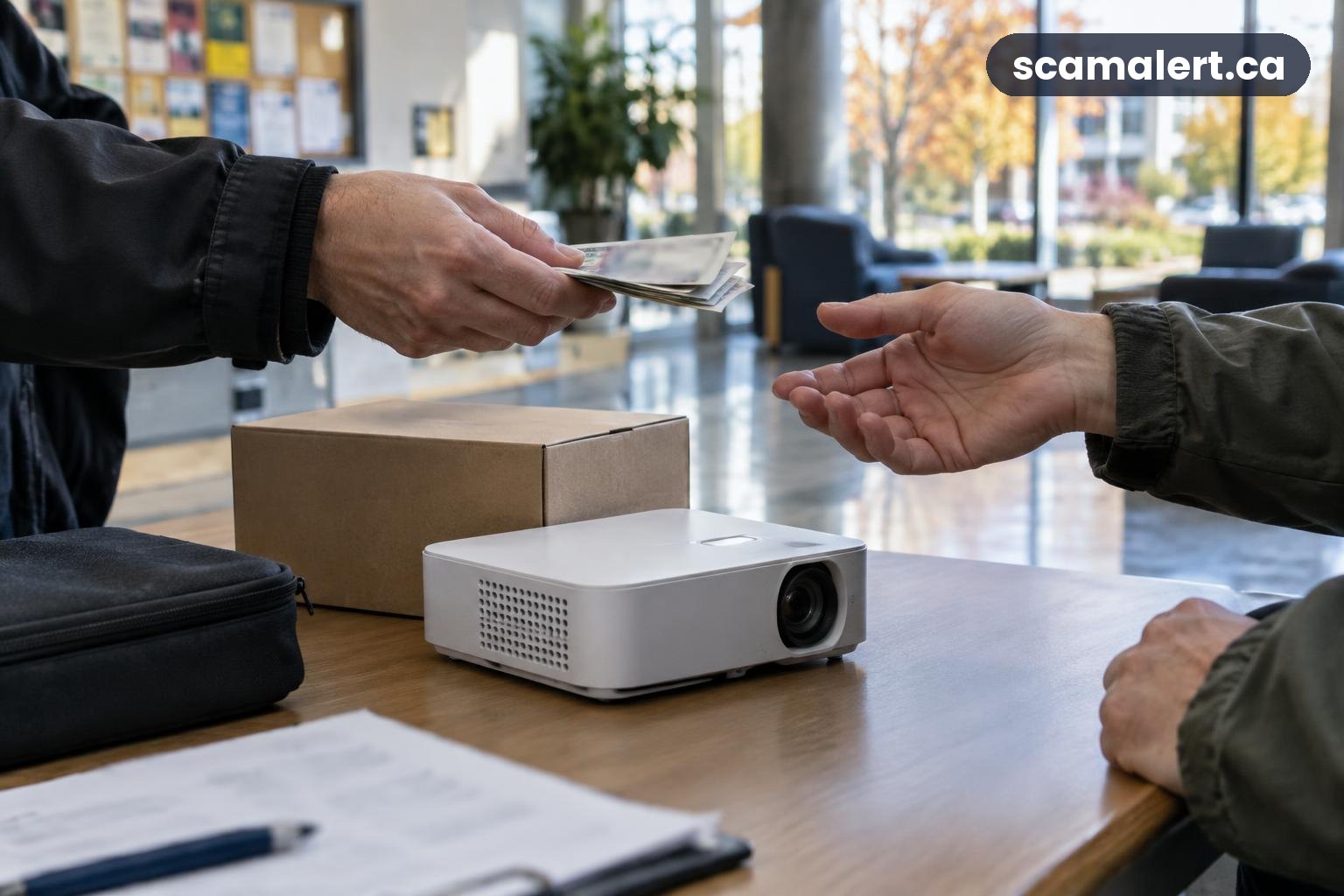
A projector sales scam case in Waterloo Region has drawn attention after CTV News reported that a Burlington man faces nearly a dozen charges. Anyone buying a projector from an online listing or a private seller can take practical steps to check the item, protect their payment and respond if a deal goes wrong.
Being charged is not the same as being found guilty. The case is a reminder to approach private sales carefully, not a reason to assume every seller or projector listing is dishonest. The guidance below applies broadly to second-hand electronics purchases.
What the projector sales scam can look like
A projector sales scam can involve an online listing, messages with a seller and a request for payment before the buyer has properly checked the product. In other private-sale situations, a buyer may meet the seller and discover that the item is missing, not as described or not working. These are common risks to consider, not claims about the Waterloo Region case.
Listings can look convincing, and a seller may answer questions promptly. That alone does not prove that the projector exists or that it will work. Photos may be copied from elsewhere, important details may be left out, and a rushed buyer may have little opportunity to test an item before handing over money.
Take time to establish exactly what is being sold. Ask for the make and model, whether the projector is new or used, what accessories are included and whether it has any known faults. If a seller cannot answer basic questions or changes the terms as you discuss the purchase, pause rather than trying to rescue the deal.
For a used projector, arrange to see it operating before payment when that can be done safely. Ask to test basic functions, such as whether it powers on and displays an image. A brief demonstration cannot guarantee that every feature works, but it gives you more information than a photograph or promise.
Red flags to watch for
- Pressure to pay quickly. Be cautious if a seller says you must send money immediately, discourages questions or claims another buyer will take the item unless you pay at once.
- Payment before a meaningful check. A request for advance payment can leave you with little leverage if the projector is never delivered. Consider whether you can inspect the item and confirm the transaction before paying.
- Unwillingness to demonstrate the projector. A seller may have a reasonable explanation for not being able to test it, but you should understand the risk of buying an untested electronic item before proceeding.
- Vague or changing details. Be wary if the model, condition, included accessories or meeting arrangements keep changing, or if the answers do not match the listing.
- Only one form of payment is accepted. Treat insistence on a particular payment method, especially one that is difficult to reverse, as a reason to stop and verify independently.
- Unusual links or requests for codes. A buyer should not need to share a banking password, one-time security code or other account access information to purchase a projector. Do not follow a payment or delivery link sent unexpectedly without checking where it leads.
- The price or offer feels implausible. A low price is not proof of fraud, but a deal that seems unusually attractive should prompt extra questions and checks rather than a rushed payment.
- The seller avoids a clear record. Be cautious if the person will not confirm the agreed price, item condition or pickup details in writing, or pressures you to move all communication elsewhere.
Safer steps for buying a projector
Use the marketplace’s own messaging and payment process where it offers one, and read its buyer-protection terms before relying on them. Keep the listing and messages. If the seller wants to switch to another platform, asks you to open an unfamiliar link or changes the payment arrangement, verify the request using the marketplace’s official app or website rather than the link in the message.
For a local pickup, choose a public place and let someone you trust know your plans. Do not go into an unfamiliar private location just because the seller says it is necessary. If the projector must be demonstrated somewhere, agree on a safe arrangement in advance and leave if you feel pressured or uncomfortable.
Check the make and model against information from the manufacturer or a reliable retailer. Ask whether the projector comes with its power cable, remote or other accessories, and consider whether replacement parts would be available. If you can test it, confirm the basic functions you care about before completing the purchase. Do not assume that a receipt, box or product photo proves the item’s history or condition.
Agree on the full price and what is included before paying. Keep a written record of the seller’s listing, messages and payment details. If you pay electronically, use a method you understand and never share account passwords or verification codes. A legitimate buyer or seller should not need you to disclose those security details.
When a seller says they are using a delivery, escrow or payment service, verify that service independently. Do not rely on a link or phone number supplied in a message. If you cannot confirm the service through its official channel, do not send money or personal information.
These precautions do not guarantee that every purchase will go smoothly. They can help you spot problems before payment and preserve useful details if you need to dispute a transaction or report suspected fraud. If anything feels inconsistent, you can walk away; you do not owe a seller an explanation for declining a deal.
What to do if you’ve been targeted
- Stop communicating and do not send more. If a seller asks for additional money, account details, passwords or verification codes, do not provide them. Avoid arguing or confronting the person in person.
- Save the evidence. Keep screenshots of the listing and messages, the seller’s profile information, payment records and any delivery details. Write down what happened while you can remember it. Do not delete the conversation or alter the records.
- Contact the payment provider promptly. If you paid through a bank, card or payment service, contact it using a number or website you find independently. Explain what happened and ask whether the payment can be stopped, reversed or disputed. There is no guarantee that funds can be recovered, but acting quickly gives the provider a chance to advise you.
- Protect any account information you shared. If you gave out a password, change it using the official service and update it anywhere else you reused it. If you shared banking details or a security code, contact your bank immediately and follow its instructions. Watch for unexpected sign-in alerts or payment activity.
- Report the listing to the marketplace. Use the platform’s official reporting tools so it can review the account or listing. Keep a copy of your report and any response.
- Report the incident. Contact the Canadian Anti-Fraud Centre and your local police. Give them the records you saved, including payment information and any available details about the seller or listing. If money or banking information was involved, contact your bank as well.
How to report it
In Canada, report suspected fraud to the Canadian Anti-Fraud Centre online or by calling 1-888-495-8501. Reporting can help authorities gather information about suspected fraud and can give you a record of your report. Include what was offered, how the seller contacted you, how payment was requested and what happened after you paid.
Contact your local police service to report the incident, particularly if you lost money, were threatened or have information about an in-person meeting. If the transaction involved money or banking details, call your bank using the contact information on your card, statement or official banking app. Do not use contact details from an unexpected message claiming to help recover your money.
If the purchase was arranged through a marketplace, report the account or listing through that platform’s official channels too. Save any confirmation you receive. A report does not guarantee that money will be returned, but keeping records and notifying the relevant organizations promptly are practical steps after a projector sales scam or other suspicious sale.
Frequently asked questions
Does a charge mean someone has been found guilty?
No. CTV News reports that a Burlington man faces nearly a dozen charges related to a projector sales scam in Waterloo Region. A charge is an allegation, not a finding of guilt; the case must be dealt with through the legal process.
Should I pay for a projector before seeing it?
Paying before you can inspect or verify an item can increase your risk, especially if the seller asks for a payment method that is difficult to reverse. Consider waiting until you can check the projector and confirm the terms. If you cannot inspect it, understand that you may have fewer options if it is not delivered or is not as described.
What if I only shared information, but did not pay?
Do not assume that no action is needed. Change any password you shared, contact your bank if you provided banking details, and watch for unusual account activity. Save the messages and report the suspected attempt to the Canadian Anti-Fraud Centre and your local police.
Source: Burlington man faces near dozen charges over projector sales scam in Waterloo Region – CTV News
Reviewed by our editorial team on .

The Scam Alert Team tracks fraud targeting Canadians and turns official warnings into clear, practical advice. Our team has a background in IT and cybersecurity, and every article is fact-checked against official sources before publication. How we verify alerts