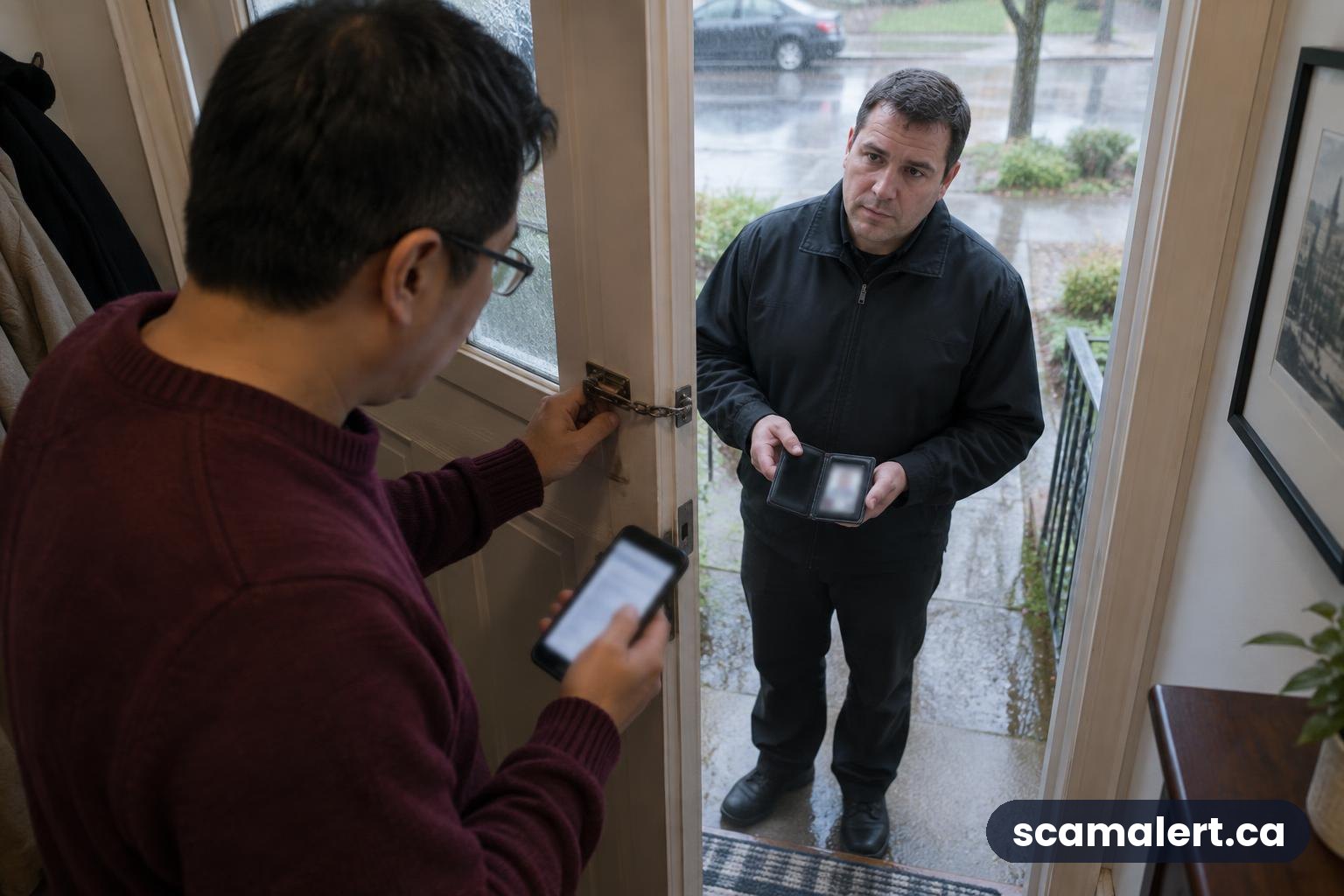
If someone calls or comes to your door claiming to be a police officer, take a moment to verify who they are before sharing information, letting them in or handing over money or property. Stay calm and do not physically confront them. If you feel in immediate danger, move to a safer place and call 911. If the situation is not urgent, contact your local police service using a number you find independently and ask them to confirm the person’s identity.
How a fake-police approach can work
An impostor may use a phone call, a visit to your home or both. They might say they are investigating a crime, that you are connected to an investigation, or that someone you know is in trouble. The claim may be designed to make you feel frightened or rushed. The person may then ask for personal or banking information, money, valuables, or access to your home.
A call can make a later visit seem more believable: the caller might tell you someone will come by, or a visitor might refer to a conversation you had on the phone. A uniform or badge can also make a claim look convincing, but appearances alone are not a reliable way to confirm someone’s identity.
Do not assume that every person who says they are police is an impostor. Instead, verify the person through your local police service. You do not have to rely on a phone number, link or instructions supplied by the caller or visitor to do that.
Variations to watch for in Canada
The story an impostor tells can change. They may claim there is a warrant, an investigation, an emergency involving a family member, or a problem with your identity or finances. In another version, the caller may say a police officer needs to collect an item or speak with you in person.
Some approaches may involve more than one contact: a phone caller sets up the story, and someone later arrives at the home. Other approaches may be limited to a call or a visit. The details are not proof that a person is a genuine officer. Treat unexpected requests for money, valuables, passwords, account details or access to your home as a reason to stop and verify independently.
Police procedures can differ depending on the situation. If someone says you are legally required to do something, do not try to settle the matter by paying the person at your door. Ask for their identity and the reason for the contact, then verify it with the police service. If you are unsure about your rights or what to do next, you can seek independent legal advice.
Red flags
- Pressure to act immediately: The person says you must decide, pay or cooperate before you have time to check their story.
- A demand for money or valuables: They ask you to hand over cash, property or a payment to prevent an arrest or resolve an alleged investigation.
- Unusual payment instructions: They ask you to pay using gift cards, cryptocurrency, a wire transfer or another method that is difficult to reverse.
- Requests for sensitive information: They ask for a password, banking details, a verification code or copies of identity documents.
- Instructions to keep the contact secret: They tell you not to speak with family, your bank or the police service’s public number.
- Resistance to independent checks: They discourage you from calling the police service directly or insist you use a number they provide.
- An unexpected request to enter: Someone wants to come inside without giving you time to verify who they are and why they are there.
One warning sign by itself may not tell you who someone is. The safest response to an unexpected or concerning request is to pause and check through an independently found contact method.
How to protect yourself
If someone calls claiming to be police, do not share personal, banking or security information during an unexpected call. End the call if you feel pressured. Find the police service’s public contact details independently, such as through its official website or a trusted directory, and call to ask whether the contact is genuine. If you think the call may be an emergency, use 911.
If someone is at your door, you can speak without opening it. Ask for the person’s name, service and reason for the visit. You can say you will verify their identity before continuing. Call the police service yourself using a number you found independently. Do not use a number the visitor gives you as your only check. If the person becomes threatening or tries to enter, move to a safer place and call 911.
Do not hand over money, valuables, bank cards, passwords or one-time security codes to someone just because they claim to be an officer. Do not let a caller or visitor direct you to a website or keep you on the phone while you try to verify them. Contact a trusted person if you need help thinking clearly or making the call.
It can also help to talk with household members about what to do if an unexpected caller or visitor claims to be police. Agree that everyone can pause, avoid sharing information and contact the local police service independently. This can be especially useful for people who may feel pressured by an authoritative tone or a frightening story.
What to do if you have been targeted
- Put your safety first. Do not confront or chase the person. If you are in immediate danger, get to a safer place and call 911. If the person has left, avoid returning to a situation that feels unsafe.
- Stop further contact and payments. Do not send more money, provide additional details or follow new instructions from the caller or visitor. Do not respond to messages that continue the same demand.
- Contact your bank if needed. If you gave banking details, shared a payment code, transferred money or handed over a bank card, contact your bank right away using the number on your card or its official website. Explain what happened and ask what steps can help protect your accounts or try to stop a transaction.
- Secure affected accounts. If you shared a password or security code, change the password from a trusted device and update any other account that uses the same password. Follow the account provider’s instructions for protecting access.
- Write down what happened. Note the date and time, what was said, how the person contacted you, what they asked for and any details that may help identify the contact. Keep messages, receipts and other records. Do not put yourself at risk to collect more information.
- Tell someone you trust. A trusted person can help you contact your bank or police service and consider what accounts or information may need attention.
- Report the incident. Contact your local police service and the Canadian Anti-Fraud Centre. Reporting is worthwhile even if you did not lose money.
How to report a fake-police approach
Report suspected police impersonation to your local police service. Call 911 if there is an immediate threat or emergency; for a non-emergency, use the service’s published non-emergency contact details. If money or banking information was involved, contact your bank as soon as possible as well as reporting to police.
You can also report the incident to the Canadian Anti-Fraud Centre online or by phone at 1-888-495-8501. Share the details you have, but do not delay contacting your bank or police if urgent action is needed. Keep copies of any records you submit.
Frequently asked questions
Should I open the door if someone says they are police?
You can speak through a closed door and verify the person’s identity by calling your local police service using contact details you find independently. If you feel unsafe, do not open the door. Call 911 if there is an immediate danger.
Can I trust a badge or uniform?
A badge or uniform may look convincing, but it is not enough on its own to confirm someone’s identity. Ask for the person’s details and verify them through the police service using a number you find independently.
What if the caller says I will be arrested unless I pay?
Do not pay or share financial information under pressure. End the call and contact the police service directly to check the claim. If you have already paid or shared banking details, contact your bank promptly and report the incident.
Should I report it if I did not lose money?
Yes. You can report the contact to your local police service and the Canadian Anti-Fraud Centre even if you did not pay or share information. If there was a threat or immediate danger, contact police urgently.